
How Agamemnon helped Odysseus get his groove back
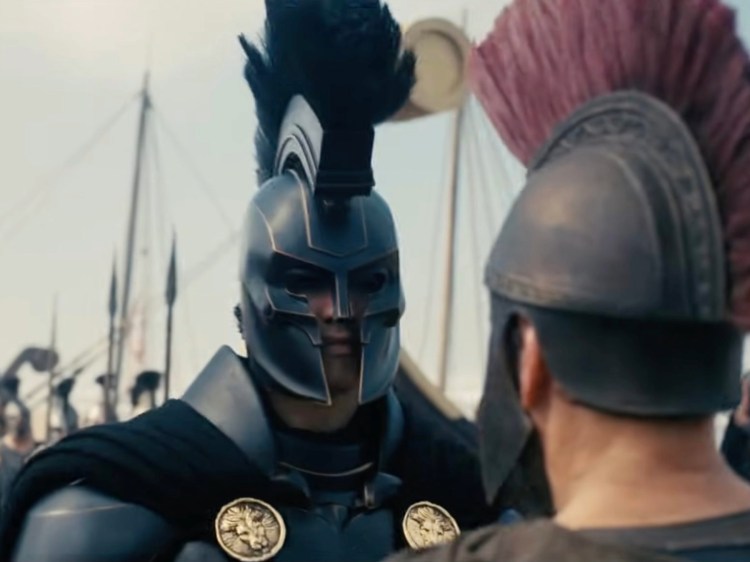
Christopher Nolan’s epic film, ‘The Odyssey’, is oddly coy about revealing the face of its Agamemnon.
It is, at points, so obviously reluctant to show the actor’s face that a cynical part of me expected that the story would contrive to have him remove his matte black, Batman-esque helmet, and reveal some manner of meta-textual stunt casting. Two-thirds of the way through a packed IMAX screening, I lost focus on the epic adventure as I pondered what actor could fulfill the required pay-off for the committed work being done to hide Agamemnon’s visage. Perhaps the one-time Matt Damon-collaborator and former Batman, Ben Affleck, would emerge from the head-piece, freshly stabbed by Clytemnestra, and wink straight down the barrel. Tonally inconsistent, arguably, but if anyone could make it work, Nolan could.
A post-viewing research trip to IMDB informs me that the role is actually played by actor, writer and director Benny Safdie, a man Nolan was happy to let audiences gaze upon unmasked in his previous opus, ‘Oppenheimer’. Or at least, so I’m led to understand. I watched ‘Barbie’ that summer; I made my choice and I’m sticking to it.
So why is it that are we never shown Agamemnon’s face in the course of ‘The Odyssey’?
To address this question, we first need to discuss Zeus’s Law, the central plot pillar of Nolan’s interpretation of ‘The Odyssey’.
Throughout the film we are solemnly advised of the sanctity of this fundamental principle of Greek civilisation. The law asks Gods-fearing folk to welcome all visitors into their homes as if they were Zeus in disguise. According to Greek myths, Zeus and his ilk were mad for this kind of gotcha ploy so it would simply have been good practice at the time, just in case.
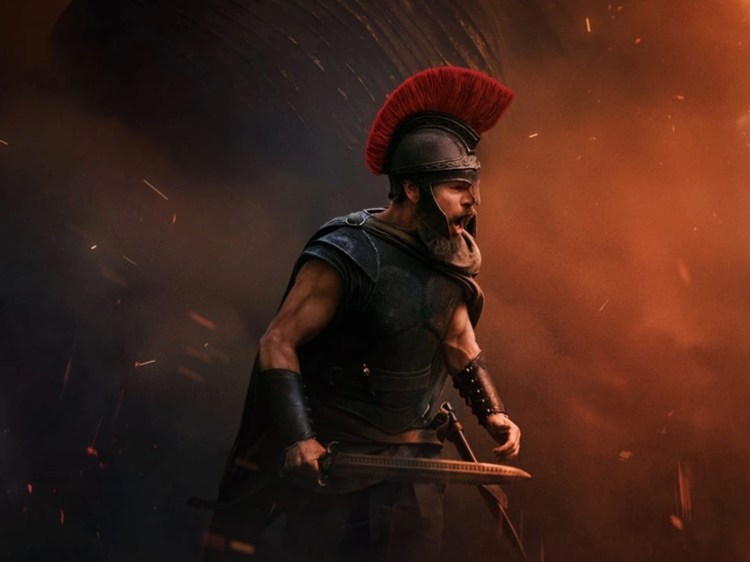
All of the good characters that we should be rooting for in Nolan’s ‘The Odyssey’ affirm the importance of Zeus’s Law, and all of the worst cads are flagged by their willingness to flout it. Penelope holds to Zeus’s Law despite the fact that it means that she must welcome the braying suitors who besiege her home. The suitors, in turn, abuse the hospitality being extended to them and further defy Zeus’s Law by calling for those of lower social status to be denied the hospitality that is also their right.
After this demand for civility has been established as a moral absolute, it is revealed to the audience that Odysseus’s Trojan Horse stratagem, rather than being a stunning display of military acumen, is, in fact, a profound betrayal of this most sacrosanct law.
While seemingly nonchalant about the notion of common-or-garden war and killing, Odysseus bridles at the sacrilegious nature of the trust-breaking subterfuge that he has devised enabling him and his team of men to be carried into Troy by the soldiers of Troy themselves. Our hero’s unease is magnified when he encounters his squire, Sinon, in the land of the dead. The soldier, who had been left, oblivious to Odysseus’s ploy, to guard the horse in which the Greeks were hidden, rebukes Odysseus for lying to him and for not trusting him. Odysseus argues that this manipulation of Sinon’s ignorance was a necessity.
Indeed, nearly all examples of Odysseus’s legendary cunning are shown to be callous and manipulative. Having been informed by the underworld ferryman, Charon, about how his crew’s encounter with Charibdis and Scylla would play out, Odysseus goads his increasingly mutinous second-in-command, Eurylochus, into steering them into the path of Scylla where Odysseus knows that six men (rather than the whole crew) will be lost. Again Odysseus decides that the ignorance of others is necessary.
Whatever else he may be portrayed as being, Odysseus is nonetheless undoubtedly the hero and moral centre of this, his own epic tale. So how can we, the audience, be convinced to throw our lot in with a figure who is so profoundly compromised by his own actions? How can Nolan have his flawed, tortured hero-cake and eat it too? This is where Agamemnon comes in.
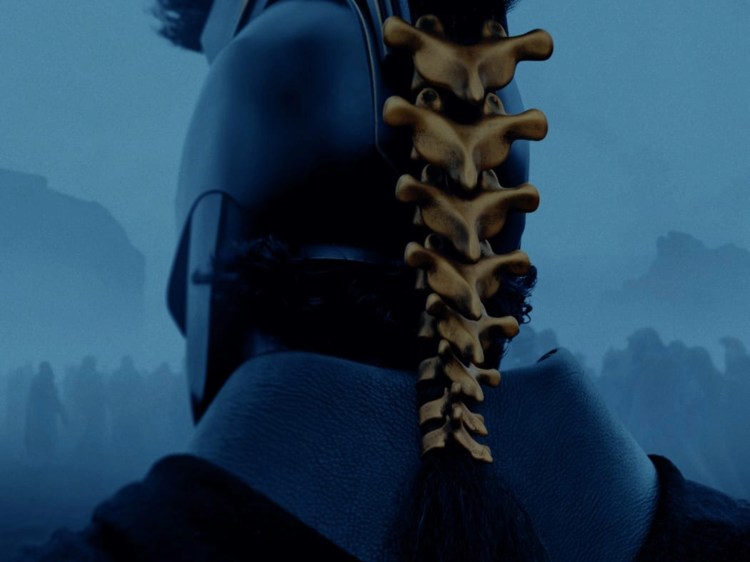
Early in the fractured course of Nolan’s telling of the epic poem, Agamemnon, king of Mycenae and de facto leader of the Greek civilisation, is identified as the driving force behind the siege on Troy. Ahead of his own departure to join the Greek forces, we see Odysseus explaining to his wife, Penelope, that Agamemnon is using the supposed abduction of his brother’s wife, Helen, as a pretext for war with Troy. The Greek leader is said to be focused on gaining control of the lucrative Trojan trade routes and is, as such, immune to any pleas for reason or leniency regarding what he already knows to be a threadbare casus belli.
To confirm this grim resolve, the story touches briefly on the sacrifice that Agamemnon makes in order to facilitate the sailing of his troops to the shores of Troy. In a swift montage, related at third hand, we see him kill his own daughter, Iphigenia, to appease the gods and garner fair winds for his fleet. It is an act that will lead to his downfall later in the story.
On the beaches of Troy, ten years into their fruitless siege, we see the masked and black-clad Agamemnon standing tall, purposeful, and totemic among the weary soldiers around him. Towards the end of the film, as Odysseus and his men open the gates of Troy, we are shown Agamemnon in the midst of the troops waiting outside, a hulking and unique presence among his uniform soldiers. He strides, steady, inexorable, and ethereal, into the breached city as chaos reigns around him. The wanton carnage that follows in Agamemnon’s almost phantom-like wake stands in direct contrast to the tense, surgical, and necessary bloodshed inflicted moments earlier by Odysseus and his fellow infiltrators.
As Troy falls we see Odysseus, exhausted and overcome, gaping in horror at the violence being inflicted upon the city by the Greek troops. If the indefatigable Agamemnon has an opinion on the tragedy that he has wrought, it is not indicated by his bearing nor discernible from behind his inscrutable mask.
Agamemnon is not a character in this film. There is no time for him to be. He is instead an allegory, an inciting incident, a propulsive narrative force, a shadowy Ares drawing power from conflict and strife, and a higher power to whom Odysseus must reluctantly answer.
Even Agamemnon’s downfall, murdered at the hands of his wife as revenge for their daughter, plays out (again in swift montages and third-hand narration) not so much as an event that befalls a character but as a shadow play illustrating the fate that might also await Odysseus on his return home. It is a cautionary tale that seeks to instill patience in the film’s audience and explain in advance the caution with which their hero Odysseus will approach reclaiming his home in the final set-piece of the movie.
Agamemnon is the implicit answer to questions that might otherwise derail the narrative. He is the superior officer for whom our hero is honour-bound to test his intellect to its limit in developing his famous equine stratagem. Odysseus strives not to destroy Troy but to escape the shadow of his obligation to Agamemnon.
Odysseus is the architect of his own sin, but it is Agamemnon who drives him to it. Even Odysseus’s decision to take the long way home is portrayed as an effort to rid himself of Agamemnon’s influence as quickly as possible.
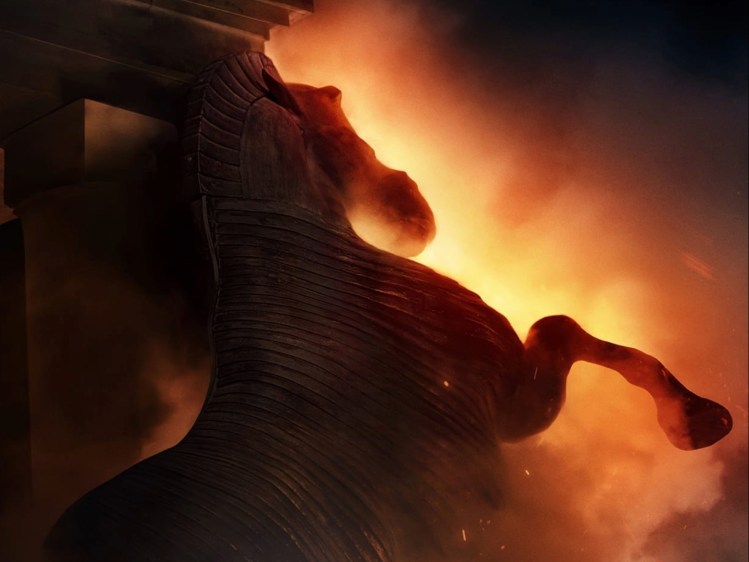
Agamemnon looms over Odysseus in the same way that Nolan’s last project, ‘Oppenheimer’ looms over his interpretation of ‘The Odyssey’. The Trojan horse, in turning an offering to the gods into a weapon, becomes this film’s atomic bomb: a world-changing and horrifying development within the theatre of war grudgingly conceived of and utilised by a tragic hero at the behest of an intractable higher power. The stratagem is portrayed as the thin end of a wedge that will tear apart the societal cohesion offered by Zeus’s Law and open the way for the decline of the Greek civilisation as a whole.
Odysseus is not responsible for starting the war with Troy, the shadow of Agamemnon reminds us, and, while our cunning hero does bear much of the responsibility for its conclusion, his culpability is offset by the presence of Agamemnon, the chaos that follows the black-helmed leader, and the heedless lust for power that he represents.
Relentless, remorseless, faceless, and cruel, Agamemnon eats the sins of our hero and, within this unfortunately ever-relevant tale of humanity finding new and innovative ways to hurt each other, he stands as an empty carapace, a dark mirror ready and purpose-made to symbolise the latest face of this never-ending cycle of martial oneupmanship.

